


NIRSE-GAL updates
Publications

Second-season observations after prophylaxis in the evaluation of the impact of nirsevimab in Galicia (NIRSE-GAL) study: mechanistic interpretation and implications for respiratory syncytial virus prevention strategy
The evaluation of the impact of nirsevimab in Galicia (NIRSE-GAL) study reported that universal infant nirsevimab prophylaxis was associated with a substantial reduction in respiratory syncytial virus-related lower respiratory tract infection hospitalisations in the first season (85·9%; 95% CI 80·2–90·0) and a substantial reduction persisting into the second season (55·3%; 95% CI 22·5–74·3). These effects were accompanied by reductions in recurrent severe outcomes, without evidence of enhanced disease or an age-related severity shift. Although this second-season observation has not yet been replicated in other cohorts and should be interpreted with caution, it raises important mechanistic questions because nirsevimab does not provide sterilising immunity. A key unproven assumption is that children spared severe disease in season one would otherwise have mainly contributed to second-season hospitalisations. If valid, several biological mechanisms would explain the sustained benefit: preservation of lung structure during important developmental windows (ie, lung-sparing), selective protection of high-risk susceptibility endotypes, prevention of severity-driven immune and epigenetic reprogramming, controlled antigen exposure, and a modest pharmacokinetic tail. The absence of enhanced disease after prophylaxis with nirsevimab is reassuring and informs sequencing of current passive and future active strategies. Together, these frameworks outline testable hypotheses for future programme-embedded research and mechanistic studies.
November 9, 2026

Nirsevimab for respiratory syncytial virus prevention: A comprehensive product review
Infant RSV prevention is undergoing a public-health paradigm shift toward scalable, broad-eligibility passive immunization. This review examines nirsevimab (Beyfortus®), a long-acting recombinant IgG1κ monoclonal antibody targeting the conserved site Ø of prefusion RSV F protein. Its extended half-life enables season-long protection with a single dose, overcoming key limitations of palivizumab. A validated manufacturing platform and stringent release specifications ensure consistent quality and potency. Pivotal trials demonstrated high efficacy against RSV-associated lower respiratory tract infection hospitalization (RSVH), while the pragmatic HARMONIE trial confirmed an 83.2% reduction in RSVH under routine conditions. Postlicensure studies across multiple countries report 70–90% effectiveness against RSVH and substantial reductions in intensive care admissions. Comparative 2024–2025 data further suggest greater protection than maternal RSVpreF vaccination. Nirsevimab represents a scalable public-health intervention that can be used alone or complement maternal RSV vaccination, warranting continued surveillance of effectiveness, safety, and viral escape.
November 9, 2026
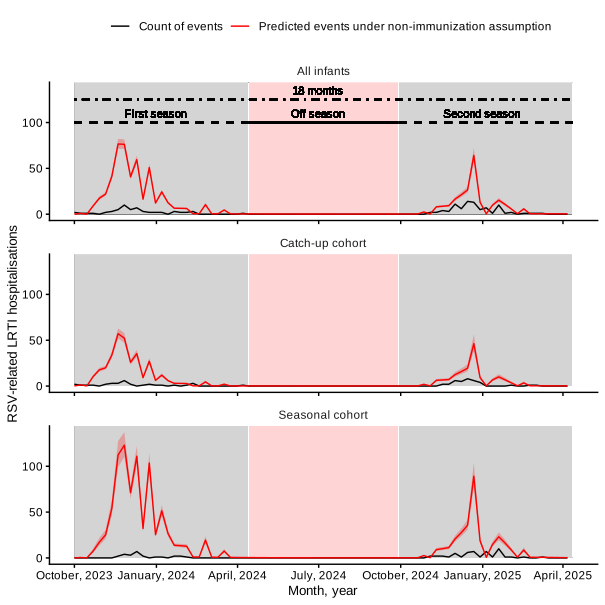
Impact of universal nirsevimab prophylaxis in infants on hospital and primary care outcomes across two respiratory syncytial virus seasons in Galicia, Spain (NIRSE-GAL): a population-based prospective observational study
Background Real-world evidence on nirsevimab impact beyond the first season when given under universal immunisation programmes is emerging. We aimed to assess the medium-term impact of universal infant respiratory syncytial virus (RSV) prophylaxis with nirsevimab across inpatient and outpatient settings during two consecutive RSV seasons. Methods NIRSE-GAL is an ongoing, population-based, prospective, longitudinal study in Galicia, Spain. For this study, we included all infants eligible for nirsevimab in the 2023–24 RSV campaign in Galicia, followed up from their first RSV season (2023–24) until the end of their second RSV season (2024–25). The primary endpoint was RSV-related lower respiratory tract infection (LRTI) hospitalisation. Secondary endpoints were LRTI hospitalisation, acute bronchitis or bronchiolitis hospitalisation, pneumonia admissions, all-cause hospitalisations, and primary health-care outcomes (acute bronchitis or bronchiolitis, wheezing or asthma, LRTI, respiratory infections, acute otitis media, and all otitis diagnoses). The first recurrences of these endpoints were also assessed as secondary endpoints. Impact was estimated by Poisson regression models using weekly incidence rates of historical non-pandemic seasons (2017–18 to 2022–23) as comparators, adjusted for RSV seasonality, and evaluated across three follow-up periods: the first RSV season, the second RSV season, and up to 18 months. This study is registered with ClinicalTrials.gov, NCT06180993. Findings Of 12 492 eligible infants, 11 796 received nirsevimab (94·4% coverage). Compared with historical cohorts, RSV-related LRTI hospitalisations decreased by 85·9% (95% CI 80·2–90·0) in the first season and 55·3% (22·5–74·3) in the second, with an estimated 123 infants needing to be immunised to prevent a second-season admission. First LRTI hospitalisations decreased by 59·8% (46·5–69·8) in the first season and 48·1% (33·1–59·7) up to 18 months. Acute bronchitis or bronchiolitis admissions decreased by 59·0% (37·9–72·9) in the first season and 58·7% (40·6–71·3) up to 18 months. All-cause hospitalisation declined by 20·3% (3·1–34·4) in the first season, with no significant reduction thereafter. First recurrent admissions in the second season decreased by 78·2% (25·6–93·6) for RSV-related LRTI, 62·4% (30·9–79·6) for LRTI, and 76·9% (5·3–94·4) for acute bronchitis or bronchiolitis. First outpatient visits declined during the first season by 30·8% (17·5–41·9) for bronchitis or bronchiolitis, 33·4% (21·6–43·4) for LRTI, and 27·7% (14·9–38·5) for wheezing or asthma. First recurrent outpatient visits also declined, by 52·5% (39·7–62·6) for acute bronchitis or bronchiolitis, 28·2% (17·8–37·3) for wheezing or asthma, and 47·3% (35·3–57·2) for LRTI. Interpretation Universal infant nirsevimab prophylaxis markedly reduced RSV-related hospitalisations and outpatient morbidity, with sustained reductions in RSV-related LRTI hospitalisations into the second season and no signal of adverse shift in RSV morbidity. These findings provide robust population-level evidence that could be valuable for infant immunisation policies and cost-effectiveness models.
November 9, 2026

Respiratory syncytial virus–related lower respiratory tract infection hospitalizations in infants receiving nirsevimab in Galicia (Spain): the NIRSE-GAL study
Respiratory syncytial virus–related lower respiratory tract infection hospitalizations in infants receiving nirsevimab in Galicia (Spain): the NIRSE-GAL study
June 13, 2025

Full 2023–24 season results of universal prophylaxis with nirsevimab in Galicia, Spain: the NIRSE-GAL study
Full 2023–24 season results of universal prophylaxis with nirsevimab in Galicia, Spain: the NIRSE-GAL study
Analysis of the effectiveness and impact of the monoclonal antibody Nirsevimab in relation to admissions for acute lower respiratory tract infection caused by Respiratory Syncytial Virus.
January 21, 2025

Full 2023–24 season results of universal prophylaxis with nirsevimab in Galicia, Spain: the NIRSE-GAL study
Media: The Lancet Infectious Diseases
Full 2023–2024 season results of universal prophylaxis with Nirsevimab in Galicia, Spain: the NIRSE-GAL study. With coverage exceeding 90%, immunization significantly reduced RSV-related hospitalizations, achieving 70.7% effectiveness for general hospitalizations and 80.3% for cases requiring oxygen support. The results highlight the positive impact of universal strategies in RSV prevention and support their global adoption.
December 13, 2024

Nirse-Gal Study protocol (Human Vaccine & Immunotherapeutics)
Assessment of effectiveness and impact of universal prophylaxis with nirsevimab for prevention of hospitalizations due to respiratory syncytial virus in infants. The NIRSE-GAL study protocol
Galicia (Spain) pioneered in implementing nirsevimab as a universal prophylactic measure against RSV. To evaluate nNrsevimab effectiveness against RSV and its severe forms and to assess the impact of nirsevimab implementation, the NIRSE-GAL study (www.nirsegal.es) was established in collaboration with the Galician Directorate of Public Health of the Xunta de Galicia. Here, we present the study protocol s considered to carry on this project.
October 29, 2024

The Lancet Infectious Diseases – Nirse-Gal Study Paper
Effectiveness and impact of universal prophylaxis with Nirsevimab in infants against hospitalisation for respiratory syncytial virus in Galicia, Spain: initial results of a population-based longitudinal study.
Galicia (Spain) was one of the first regions worldwide to incorporate nirsevimab for universal respiratory syncytial virus (RSV) prophylaxis in infants into its immunisation programme. The NIRSE-GAL longitudinal population-based study aimed to assess nirsevimab effectiveness in preventing hospitalisations (ie, admittance to hospital).
May 1, 2024

The Journal of Infectious Diseases
Preparing Europe for Introduction of Immunization Against RSV: Bridging the Evidence and Policy Gap.
On the cover: RSV Immunization: From Bench to Arms. The first picture is from the immunization campaign in Galicia, Spain this winter, where they successfully immunized all their children under one year of age with spectacular results. Credit: Prof Federico Martinon-Torres and Mr Carlos Bermello. The second picture is of Prof Barney Graham, who led the discovery of the structure of the F protein that revolutionized the field of RSV vaccines. He is holding a 3D model of the structure of the F protein while getting immunized at Walgreens community pharmacy last autumn. Credit: Dr. Cynthia Turner-Graham.
March 19, 2024

Eurosurveillance
Martinón-Torres F, Mirás-Carballal S, Durán-Parrondo C.
Early lessons from the implementation of universal respiratory syncytial virus prophylaxis in infants with long-acting monoclonal antibodies, Galicia, Spain, September and October 2023.
March 19, 2024
Conferences and congresses


